

Brandon Mason
Phone
(917) 924-2145
Email
[email protected]

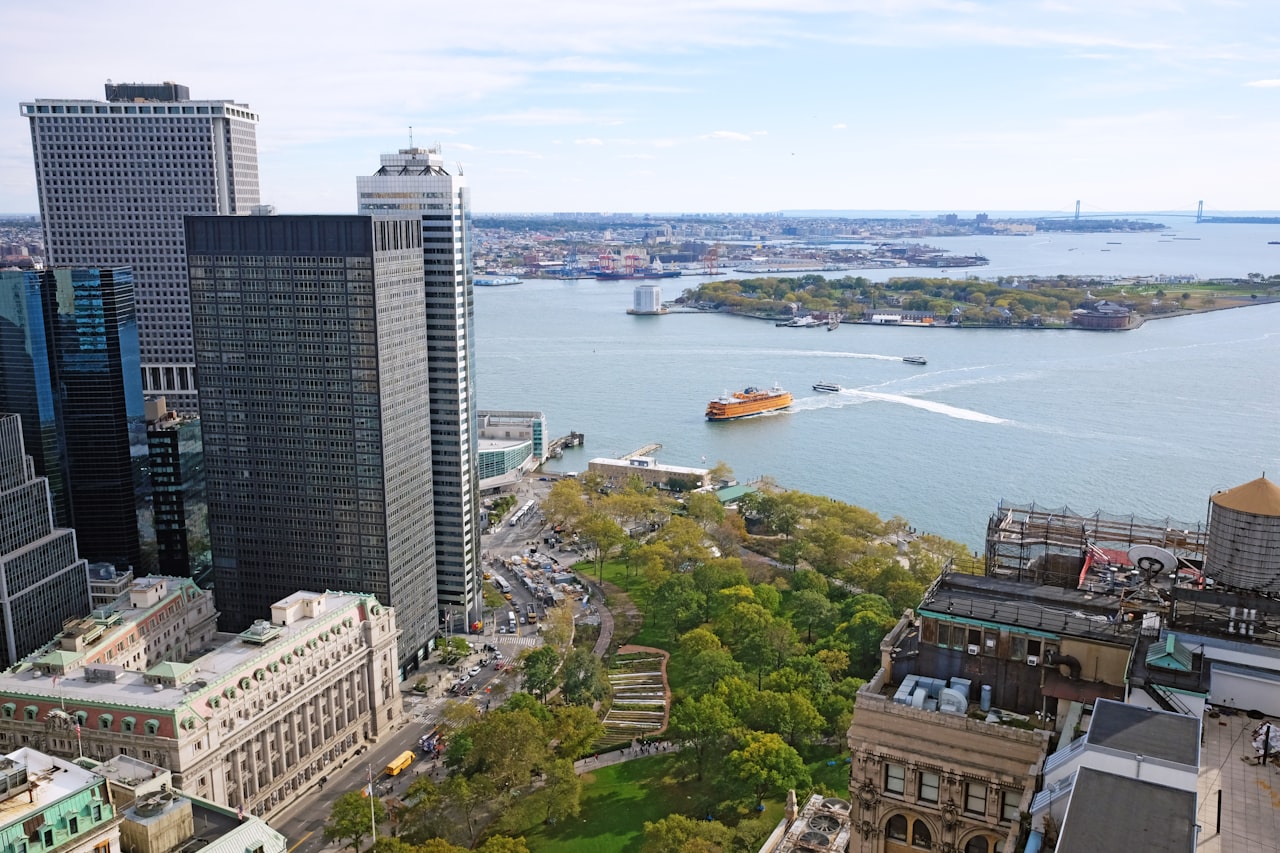
Bordered by the Hudson River, this planned community offers a peaceful escape from the hustle and bustle of the city while maintaining proximity to key attractions.
Before Battery Park City had a single resident, it had a wheat field. In 1982, artist Agnes Denes planted two acres of golden wheat on the still-empty landfill, two blocks from Wall Street, on land valued at the time at 4.5 billion dollars. She and her assistants dug 285 furrows by hand, tended the crop for four months, and harvested nearly a thousand pounds of grain in the shadow of the World Trade Center, a deliberate confrontation, in her words, with waste, world hunger, and misplaced priorities. The wheat field is long gone, but it captures something true about the neighborhood that grew up on that same landfill afterward: Battery Park City's serenity is not inherited from history. It is manufactured, on land that did not exist fifty years ago, on a site people used to protest the very forces that later built it.
History and Etymology
Battery Park City sits on 92 acres of landfill that did not exist before the late 1960s. The land was created using excavated soil and rock from the construction of the original World Trade Center, supplemented by material dredged from New York Harbor, filling in a stretch of derelict, obsolete piers along the Hudson River. New York Governor Nelson Rockefeller proposed the project in 1966, and the state legislature created the Battery Park City Authority in 1968 to oversee it. The landfill was substantially complete by the mid-1970s, but the neighborhood itself sat largely undeveloped and empty for years afterward, used in the interim for temporary public art installations, including Denes's wheat field, before construction of the first residential buildings began in 1980.
The 1979 master plan, designed by the firm Cooper, Eckstut Associates, treated Battery Park City as a direct extension of Manhattan's existing street grid rather than a self-contained superblock development, a deliberate choice intended to integrate the new neighborhood into the city's fabric rather than isolate it. The plan dedicated roughly a third of the site to public parks and open space, a ratio that remains unusually generous for Manhattan and defines the neighborhood's character today. Gateway Plaza, the first residential complex, broke ground in 1980, and the office towers now known as Brookfield Place followed shortly after.
The retail and office complex now called Brookfield Place operated for decades under its original name, the World Financial Center, before being rebranded in 2013 following a quarter-billion-dollar renovation intended to reposition it as a luxury shopping and dining destination. The complex, designed by architect César Pelli, suffered severe damage during the September 11 attacks due to its direct proximity to the World Trade Center; its Winter Garden Atrium, a glass-domed public space filled with palm trees, was heavily damaged and did not reopen until exactly a year later, on September 11, 2002. Le District, a French-themed food hall inside the complex, remains open today, though L'Appart, a Michelin-starred restaurant that operated within it, closed in early 2024 and was converted into private event space, a reminder that even Brookfield Place's more ambitious dining ventures have not all endured.
Battery Park City's waterfront esplanade and its string of parks, including Rockefeller Park, Teardrop Park, and Wagner Park, are maintained by the nonprofit Battery Park City Conservancy and offer some of the most consistently uninterrupted water views available anywhere in Manhattan, looking directly out toward the Statue of Liberty and Ellis Island. Because the entire neighborhood sits on reclaimed land immediately beside the Hudson, resiliency against flooding and storm surge has become a defining civic concern in the years since Hurricane Sandy caused significant damage here in 2012, and the Authority has since invested heavily in coastal protection infrastructure.
Battery Park City's proximity to the World Trade Center meant the neighborhood bore direct, severe impact from the September 11 attacks: residents were evacuated, buildings were damaged by falling debris and toxic dust, and the community's recovery over the following years became closely tied to the broader rebuilding of Lower Manhattan. That history is not incidental to the neighborhood's identity. It shapes, still, how seriously Battery Park City residents and its governing Authority treat questions of resilience, safety, and long-term planning.
Battery Park City draws families and professionals specifically seeking the combination of waterfront parks, strong schools, and proximity to the Financial District without the density and noise of neighborhoods farther uptown. It's the quietest place in Lower Manhattan, and that's by design, not by accident. Every part of this neighborhood was planned, right down to the parks.
The standard comparison is to Roosevelt Island, another planned, car-light residential community built on reshaped land at roughly the same historical moment. The comparison holds on planning philosophy and pedestrian-first design. It breaks down on origin and integration: Battery Park City was built as a direct extension of Manhattan's street grid and sits inside the same borough and community board structure as its neighbors, while Roosevelt Island remains physically and administratively more separate, connected to the rest of the city by tram and a single subway line rather than woven into the surrounding grid.
There's plenty to do around Battery Park City, including shopping, dining, nightlife, parks, and more. Data provided by Walk Score and Yelp.
Explore popular things to do in the area, including Zanzani Gabriella, Nia John Makeup, and InstaGlam By Alla.
| Name | Category | Distance | Reviews |
Ratings by
Yelp
|
|---|---|---|---|---|
| Shopping | 0.73 miles | 0 reviews | 0/5 stars | |
| Beauty | 0.5 miles | 0 reviews | 0/5 stars | |
| Beauty | 0.52 miles | 0 reviews | 0/5 stars | |
|
|
||||
|
|
||||
|
|
||||
|
|
||||
|
|
||||
|
|
6,419 people live in Battery Park City, where the median age is 40 and the average individual income is $194,763. Data provided by the U.S. Census Bureau.
Total Population
Median Age
Population Density Population Density This is the number of people per square mile in a neighborhood.
Average individual Income
With over a decade of expertise in Manhattan and Brooklyn, Brandon Mason looks forward to providing you with a real estate experience that is second to none. Feel free to explore our website, and contact Brandon with any questions you may have.
Let's Connect